

Have you ever wondered why short animated loops can spark such big conversations across online fandoms and media?
Futa—from the Japanese term futanari—describes characters with both male and female traits. This article defines the term plainly and sets a neutral, informational tone.
GIFs thrive because they loop instantly, deliver quick impact, and fit social feeds better than long videos. That combination makes this niche pop up in many streams of digital art and entertainment.
Generative intelligence and creativity let creators make new, stylized loops fast. That opens fresh paths for fantasy, erotic content, and experimental art, while also raising debates about objectification and body standards.
This space moves quickly. You will learn the origins in anime and manga, why looping visuals work so well, what drives the trend, and how creators craft generated animations.
Key Takeaways
- Futanari refers to characters with mixed physical traits; this piece stays neutral and informative.
- Short loops gain traction because they are instantly shareable and engaging.
- Generative tools reshape digital art, enabling rapid, novel visuals.
- The niche blends fantasy and adult content and sparks debate on representation.
- Later sections explain origins, trends, and hands-on creation of generated loops.
Futa in digital art and animation: meaning, origins, and why it shows up in GIF culture
The term traces back to Japanese pop culture and moved fast into digital spaces. Futanari, often shortened to futa, names characters who blend male and female primary traits in anime and manga. This label appears across genres, from comedic panels to more stylized adult works.
What futa and futanari mean, and how they moved into modern media
Creators translated the concept from print to short animation and other online media. Stylization helps: a few clear traits signal a character’s mixed anatomy instantly. Artists rely on visual shorthand so viewers grasp identity without long exposition.
Why looping animation fits this niche
Looped motion magnifies expression. A tiny gif highlights facial cues, timing, and subtle movement. Simple squash-and-stretch, eye shifts, or a hair toss can sell mood, flirtation, or humor in seconds.
“A few frames can tell a scene as well as a paragraph.”
Shareability matters. Lightweight files embed easily in chats and threads, helping niche characters spread quickly across communities. The next section will show how technology speeds up creation and variety.
Why ai futa gif content is trending right now
Low barriers and fast feedback loops have changed how niche visual content spreads online.
Faster creation cycles let artists and creators iterate quickly. Instead of weeks, a new loop can appear in hours. That speed encourages experimentation and keeps content fresh.
How tools speed up creation and expand style
Generated futa and generated futa gif workflows allow testing many looks without a full animation pipeline. Creators can swap poses, lighting, and art direction in minutes.
Style remixing is common. One loop can blend anime cues, painterly brushwork, and cyberpunk lighting. This variety keeps niche content interesting for fans and artists alike.
Where communities gather and how they shape trends
Platforms like Reddit and specialized forums are central hubs. Creators share prompts, compare techniques, and critique results. These conversations form feedback loops that raise quality fast.
“Shared prompts and model choices often define short-lived trends across creator groups.”
- Why loops do well: instant readability, easy reposting, and quick reactions.
- Community role: feedback, prompt recipes, and model recommendations drive what spreads.
- Ongoing debate: visibility sparks questions about representation and fantasy versus objectification.
How AI-generated futa GIFs are made: tools, techniques, and creative workflow
Modern workflows mix image models and frame tools to turn single visuals into short, smooth loops.
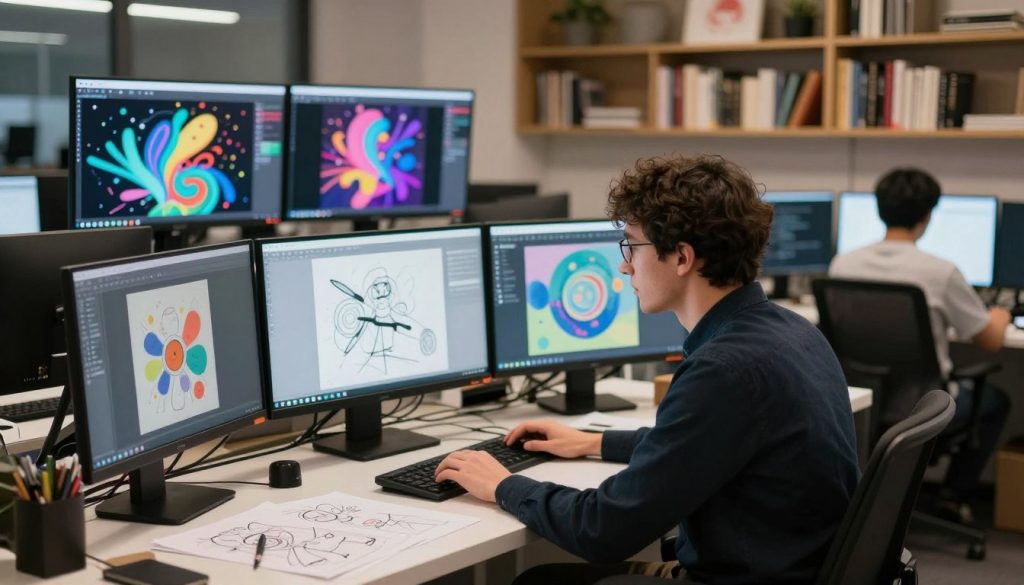
The core technology in plain English
GANs use two networks that compete: one makes images and the other judges them. This rivalry raises realism over time.
Diffusion models start with noise and stepwise remove it to reveal a picture. Both methods power fast visual development.
Pipeline and training data basics
Typical development flows: concept → generation → selection → refinement → loop polish. Quality datasets shape anatomy consistency and style range.
Limited or biased data creates repeatable stereotypes, so ethical sourcing matters for artists and production teams.
Prompt engineering and keeping motion coherent
Prompts name the character, anatomy, pose, art style, lighting, and facial expressions that sell emotion. Short, clear prompts speed iteration.
Frame consistency uses shared seeds, reference frames, and interpolation to smooth motion and avoid jumpy resets.
Refinement, finishing, and creative boundaries
Common fixes include inpainting for artifacts, outpainting for wider scenes, frame interpolation for smooth motion, and color grading for mood.
Creators can customize poses, niche aesthetics, and expressions while watching for quality and ethical boundaries.
| Step | Purpose | Tools |
|---|---|---|
| Concept | Define character, mood, loop length | Sketch, prompt templates |
| Generation | Create candidate frames | GANs, diffusion models |
| Refinement | Fix artifacts and timing | Inpainting, interpolation |
| Polish | Color grade and finalize loop | Compositing, export tools |
“A tight prompt and a few careful passes make the difference between a rough render and a polished loop.”
Conclusion
Tiny animated loops make dense expression feel immediate and shareable. In short, futanari and related forms find a natural home in looping media because a few frames can signal identity, mood, and intent quickly.
Generated futa workflows accelerate volume and style variety, giving creators faster iteration and more choices while human taste still guides final edits. Platforms and community feedback push aesthetics forward and help good work spread.
This niche can include explicit porn and fantasy, and it sits alongside active conversations about ownership, bias, and misuse. If you are curious, focus on the practical workflow—prompts, frame consistency, and post-processing—and the ethical constraints creators face.
Looking ahead, expect more coherent animation, greater personalization, and continued debate about boundaries. This world of short loops remains one evolving corner of digital art, shaped by technology, creators, and culture in real time.
FAQ
What does "futanari" mean in anime and manga?
Futanari refers to a fictional character type in Japanese media that blends male and female sexual characteristics. It originated in manga and doujinshi and later appeared across anime and related art forms. Creators use the term to explore fantasy themes, character design, and niche storytelling within erotic and non-erotic works.
Why do these characters appear often in short looping visuals?
Short looping visuals emphasize expressive moments and character reactions. Looped clips are easy to share on social platforms, fit attention spans, and let artists highlight specific aesthetics, poses, or emotions without producing full-length animations. The format supports fast sharing and community engagement.
How has automated image technology changed creation and style options?
Recent tools speed up concept-to-visual workflows and let creators experiment with varied art directions. They help produce consistent character sheets, explore new aesthetics, and iterate quickly on anatomy and expressions. This broadens the range of styles available to both independent artists and studios.
Where do creators and fans gather to share these visuals and discuss techniques?
Communities form on dedicated forums, art platforms like Pixiv and DeviantArt, social sites such as Twitter and Reddit, and private servers on Discord. These spaces host critique, tutorials, and collaboration while shaping trends and norms in the niche.
What core technologies power generated animated visuals like these?
Modern generation relies on neural networks such as generative adversarial networks and diffusion-based models. In plain terms, these systems learn patterns from many images to create new frames, enabling stylized characters, texture details, and coherent motion across frames.
Why does training data quality and variety matter?
High-quality, diverse training examples improve realism, reduce artifacts, and expand stylistic range. Poor or biased datasets can produce unrealistic anatomy, repeat errors, or limit expression. Good data practices help creators achieve more natural motion and faithful character details.
What is prompt engineering for character visuals and animation?
Prompt engineering means crafting clear, specific instructions to guide model output. For character work, it covers anatomy, facial expressions, clothing, setting, and desired artistic style. Better prompts produce more accurate poses, consistent proportions, and targeted aesthetics.
How do creators keep animation coherent between frames?
Coherence relies on consistent character rigs or reference frames, frame-to-frame interpolation, and model constraints that preserve facial features and limb placement. Techniques like motion vectors and temporal conditioning help maintain continuity and enable smooth loops.
What post-processing steps refine generated animations?
Common steps include interpolation to smooth motion, inpainting to fix artifacts, outpainting to expand scenes, and color grading to unify the palette. Manual touch-ups in editing software help correct anatomy, enhance lighting, and polish final visuals.
What aspects can creators customize when making character loops?
Creators can adjust poses, expressions, wardrobe, fantasy scenarios, lighting, and background details. They also refine niche aesthetics—like anime-inspired rendering, realistic shading, or stylized cell shading—to match audience expectations and platform standards.
Are there ethical and legal considerations creators should know?
Yes. Creators must respect copyright, platform content policies, and consent norms. Using licensed assets or clear-sourced references reduces infringement risk. Many platforms restrict explicit adult content, so understanding site rules prevents removal or account action.
How can newcomers learn these tools and techniques safely?
Start with beginner tutorials on art platforms, follow reputable creators on YouTube or Patreon, and join community servers for feedback. Practice with non-explicit projects to learn animation basics, then gradually explore advanced workflows while following legal and platform guidelines.